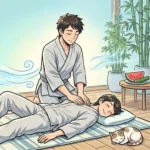
” Reconnecting with one’s body ” is one of the most rewarding effects of Shiatsu therapy, for both the therapist and the receiver. Some people grasp this concept immediately; others are less attuned to it. So, let me offer a brief explanation, without turning it into a philosophy thesis.
At the beginning of this winter, an active woman in her early fifties came to my Shiatsu practice. Having undergone several medical procedures for kidney stones, she expressed:
- a sense of sadness linked to bereavement,
- chronic neck tension,
- minor irregularities in her cycle,
- and a fear of cold and dampness.
The accumulation of these symptoms had left her feeling fragile and deeply affected.
After two months of regular sessions, the progress report was clear: the client “feels better,” even though the winter—particularly cold and rainy—wasn’t over yet. On top of that, she faced personal frustrations during this period and the recurrence of neck tension related to her work. However, what truly changed was a newfound sensitivity to her own body and the sense of peace that comes with it.
Two more months passed as spring arrived. Sessions became less frequent, and the client arrived in much better shape. She had grown used to this “time for herself” and clearly identified both its benefits and its necessity.
Receiving Shiatsu didn’t transport her into an “ideal,” symptom-free body; it simply anchored her back into the living body that has been with her since day one. She felt a profound sense of relief. I take the liberty of sharing this because those were her own words.
In my practice, there is no shortage of examples highlighting the vital connection between body and mind, and how effective Shiatsu is in helping individuals reclaim their bodies and the immense potential they offer. Far from the false promise of a “magical cure,” Shiatsu is primarily a form of support—a mediation between two aspects of the same person: the mental and the physical.
The Body-as-Object: A Western Dominance
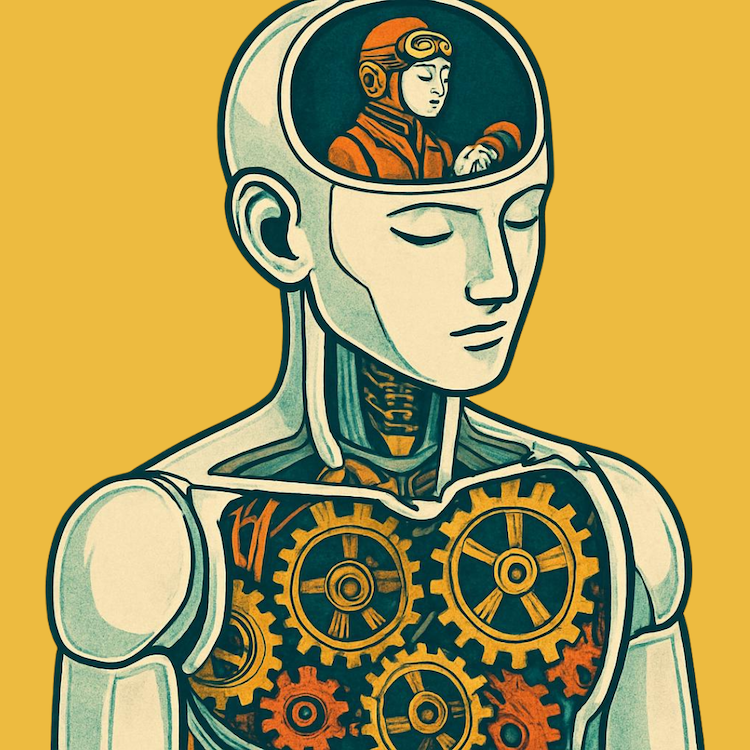
Much has been written about the Western conception of the body, famously described by Descartes as a “machine made of earth,” and the excesses caused by this materialistic approach. Let’s acknowledge, however, that this perspective has led to great advances in human health. The mechanical and chemical understanding of the body and its environment has warded off countless epidemics, pains, and premature deaths.
On the flip side, this knowledge of the “body-as-object” has fostered an illusion of the mind’s omnipotence—a belief shared by some healthcare providers and patients alike. Everything seems possible thanks to medical progress. Taken to the extreme, this logic leads to the “transhumanism” that fascinates the world’s most powerful figures.
More commonly, entire social groups neglect the basic rules of healthy living: rest, a balanced diet, or physical exercise. Often out of duty, sometimes by choice, they exhaust their bodies and expect healthcare providers to “fix” the consequences of this lifestyle. They are met by doctors who are increasingly specialized and under the pressure of this consumerism. Equipped with ever-more effective tools, providers respond to the immediate demand, targeting the specific pathology without always placing it in a broader context: the overall well-being of the person. This is how the body-mind divorce—and the disorders it creates—develops.
To be fair, Descartes himself warned his contemporaries against this drift: “I am not merely lodged in my body as a pilot in a ship.” In other words, the mind is not entirely separate from the body.
The Body-as-Subject in Eastern Thought
The body-mind relationship is described quite differently in Asian thought, particularly within Taoism. This ancestral vision views Qi as a universal flow governing all living things, including human beings. This flow interacts as much with the psyche as with the physical, bound together by a single vital movement. An emotion triggers physical phenomena, just as physical alterations are accompanied by psychological effects.
Traditional Chinese Medicine (TCM) creates many such bridges and serves as the theoretical foundation for Shiatsu. Simply put, we manipulate a body, but we aim for a general effect on the whole person, bringing them closer to a beneficial energetic balance. This is neither visible nor quantifiable, which may bother some. Personally, I delight in seeing the results: the disappearance or improvement of symptoms and the reconciliation of matter and spirit.
Shiatsu, a Japanese technique of manual pressure on meridians and acupuncture points, effectively supports this transition from having to being.
- Touch as a Dialogue: As practitioners, we don’t “repair” a broken part. The massage invites the receiver to become aware of their areas of emptiness and tension once again.
- Fully Inhabiting Your Inner Space: For the receiver, you aren’t just undergoing a neutral manipulation; you are reconnecting with deep sensations and fully becoming your body again.
Many clients come to the office complaining of mechanical malfunctions and leave with a refreshed mind. To move from “having” to “being” is to recognize that our health is not merely the absence of symptoms, but a global harmony and a relationship with life itself.